Essay · May 11, 2026
ChatGPT Plus: From upgrade to habit
I upgraded to ChatGPT Plus for Codex. Here's what it revealed about the premium user journey.
I upgraded to ChatGPT Plus after seeing Codex all over X. As a Claude Code power user and PM, I had a direct baseline to compare against. Codex surprised me with how powerful it is. The UX was sleek and intuitive, the integrations set up fast, and computer-use felt genuinely autonomous, but it still hasn't become my default.
In my first session alone, the gaps were obvious: I still had to do too much work to understand what I was paying for and how to make it stick.
ChatGPT's paid features are genuinely powerful, but the harder problem is helping users find them, learn them, and build them into a daily workflow. Codex is where I felt those gaps most acutely, but the activation problem runs across every premium use case.
Clear intent, weak activation
The friction started before I even reached the pricing page. I clicked upgrade from the desktop app and landed on the browser homepage instead. This doesn't happen on web or mobile. It's a table stakes fix, a single redirect, but it breaks the flow at the moment a user is trying to pay.
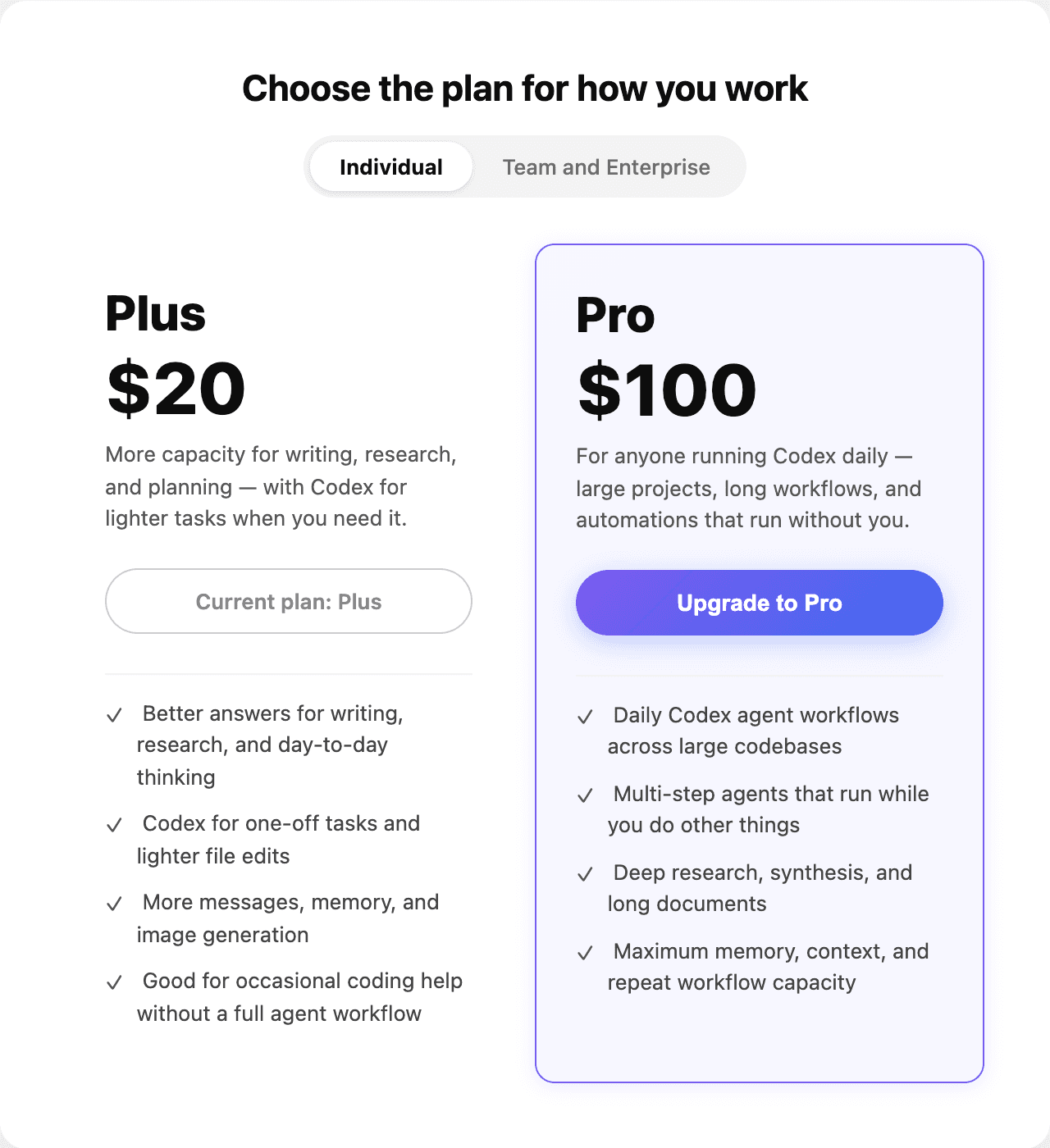
Landing on the pricing page didn't simplify the decision. It listed features by plan, but I still had to figure out which plan fit my needs. I wanted the page to tell me which plan was right for me: was I buying daily productivity, coding agents, research depth, or larger project capacity? I eventually chose Plus, but the page was asking me to map features to my own needs. That's the product's job, not mine.
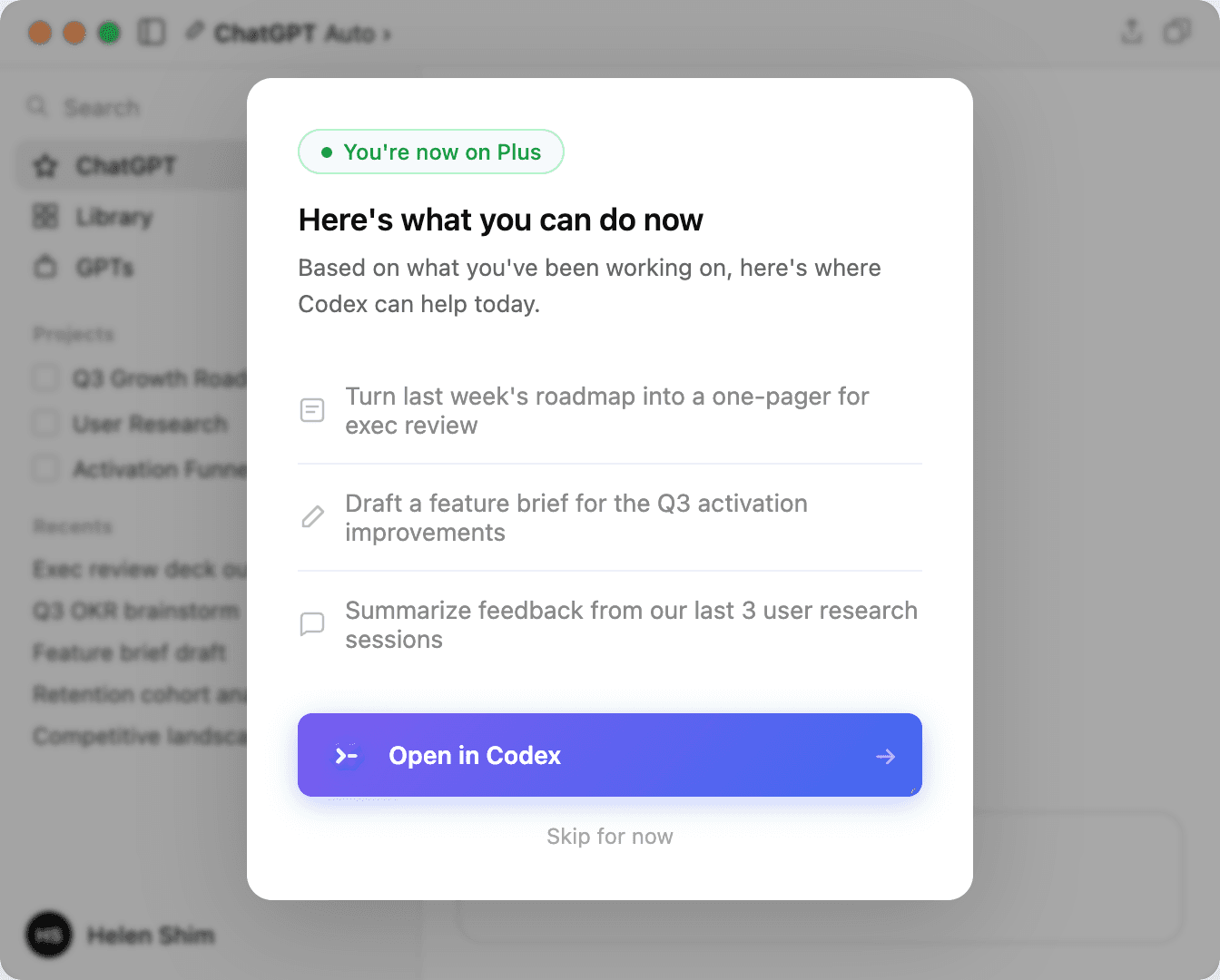
After I paid for Plus, Codex still prompted me to upgrade until I logged out and back in. That's the highest-intent moment in the entire funnel, and it went unacknowledged.
Powerful but not yet sticky
The MCP checklist, suggested prompts, and inline previews got me productive fast. My first session felt structured and purposeful.
Once I was through onboarding, there was no clear next step. I still needed a friend to learn the features that made Codex click. That's a design gap: the most effective discovery mechanism wasn't in-product — it was social. A feature surfaced by a peer feels like a tip, not a tutorial. That's the feeling ChatGPT needs to replicate in-product.
Features like computer-use and annotation mode are genuinely powerful, but the product has no way to surface them. Annotation mode lets you mark up a live preview and prompt Codex to apply changes directly, keeping non-engineers out of the code entirely. The model could also be more opinionated: pushing back, surfacing next steps, tracking intent across sessions.
How to close the gap
Getting to paid: optimize the funnel and pricing page. Clicking upgrade should take users directly to the pricing page, not the homepage. Once the user lands there, they should understand which plan best fits their needs. That requires the plans to speak in user jobs and value props, not feature lists (daily productivity for professionals, coding agents for engineers). Users who can't identify which plan fits their needs are more likely to churn before they convert.
The first paid moment: context-driven premium actions. Right after upgrading, the product should surface personalized prompts based on what it already knows. Not a feature list, but prompts rooted in your actual work that make the value feel immediate. That's what gets a user to try what they just paid for.
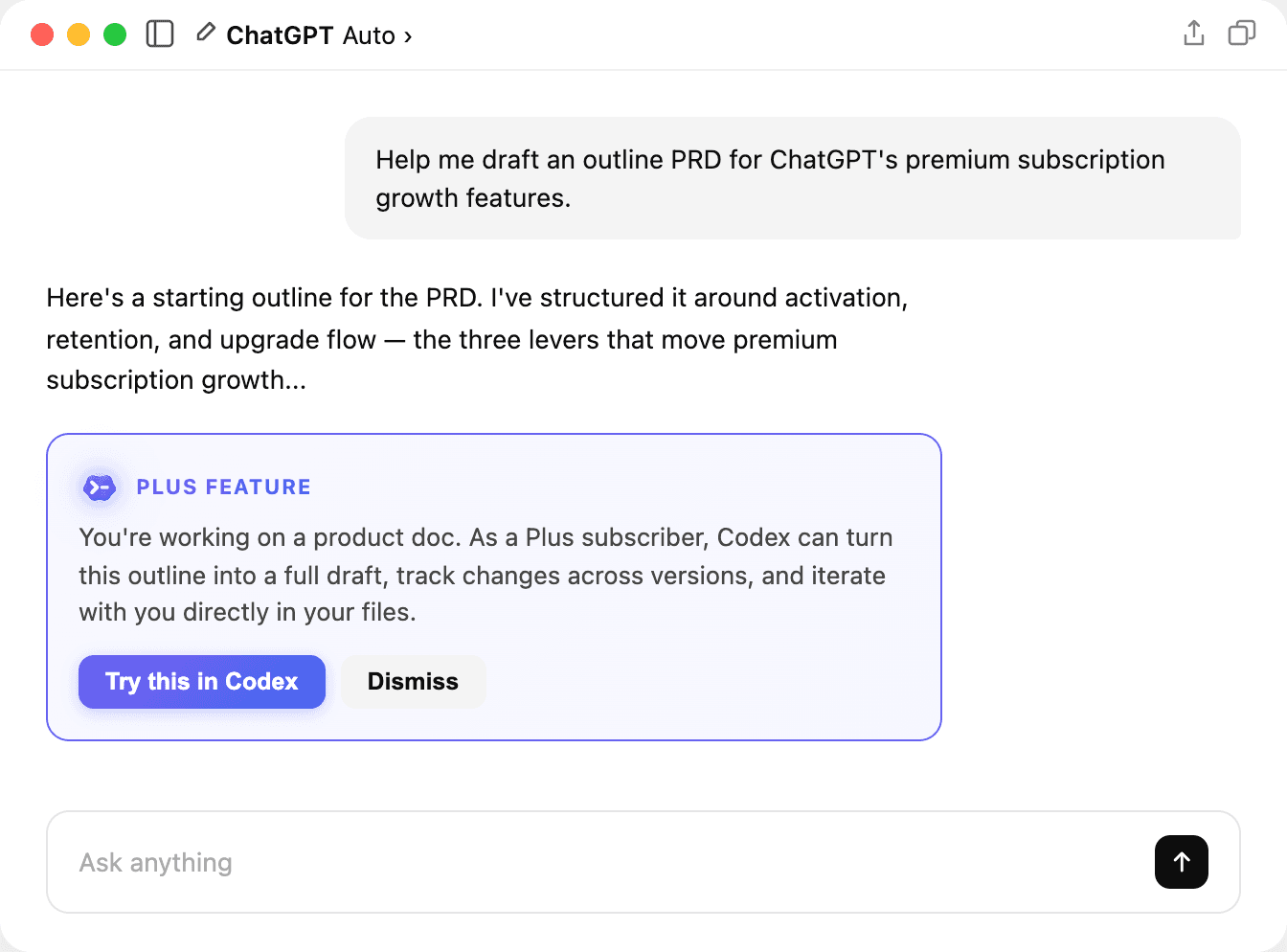
In-chat: meet users at the moment of intent. The same logic applies inside chat: the first time you show coding or automation intent, connect the dots inline. “As a Plus subscriber, Codex can handle this for you.” Discovery shouldn't require browsing a menu. That nudge, surfaced at the right moment, is what turns a subscriber into a power user.
Once the habit forms, make annual easy. Activation drives habit. Monthly subscribers who've found a workflow should have a clear path to annual, surfaced at the right moment rather than at sign-up. I ran into this myself: after three weeks of daily use, I was ready to commit long-term but had no way to switch from within the app. A subscriber actively trying to pay more and hitting friction is a missed revenue opportunity with almost no cost to fix.
The metrics I'd track
30D retention by tier is the top-line metric, but it's a lagging indicator. A user can convert, fail to activate, and churn long before they ever cancel. Thirty days captures the highest-risk churn window and the first billing cycle. It's also fast enough to run experiments against. The more actionable question: what behavior in week one predicts day-30 retention?
That's why I'd anchor on weekly completed agent tasks in Codex as the north star. Codex is where the value of Plus is most immediate for a new subscriber. Completing a real task there is a strong early signal that the habit is forming.
Memory has no discrete activation moment, and deep research users are largely already converted. That makes Codex the clearest activation signal for developers and adjacent builders (PMs, designers). For other segments, the specific workflow changes, but the logic holds: find the one thing that makes the subscription feel worth it, and get users there in week one.
The activation milestone I'd set is one completed Codex agent task within seven days. The bar scales with the tier: Plus activation means a real single-step coding workflow. Pro activation means a complex, multi-step task. At $100 a month, Codex needs to execute complex work end to end and sustain the momentum of your full workflow.
From habit to go-to
Friction before the first workflow kills activation. Friction after kills retention. For OpenAI, this is the difference between a premium user churning at month one, and ChatGPT becoming the default for how they work.